Annual Reports
Salesforce, Inc.'s annual reports contain management's most considered account of the business. These are the sections, passages and visual pages worth opening in the originals preserved in Sources.
Salesforce, Inc. — FY2026 Annual Report (Form 10-K) — FY2026
Latest 10-K; the year Salesforce rebranded its clouds under Agentforce, closed the Informatica deal, and crossed $41.5B revenue. · Open the full document →
Item 1. Business — p. 6 · Read the full section →
Management's own framing of the pivot from CRM software to an AI-agent platform, and how it sells.
How Salesforce describes itself in FY2026: a CRM leader remaking every customer into an “agentic enterprise.”
Salesforce, Inc. (“Salesforce,” the “Company,” “we” or “our”) is a global leader in customer relationship management (“CRM”) technology, helping organizations of any size become agentic enterprises. Founded in 1999, we bring humans, agents, applications, and data together on a trusted, unified platform to unlock growth and innovation. […] With Agentforce, the agentic layer of the Agentforce 360 Platform, our customers can build and deploy always-on digital labor for employees and customers, leveraging autonomous AI agents across business functions that aim to increase productivity, lower costs and drive operational efficiencies.
p. 6 · Read in context →
Item 1A. Risk Factors — p. 19 · Read the full section →
The two risks most specific to Salesforce right now: acquisition digestion (Informatica, Slack) and AI reshaping its own markets.
Acquisition risk — the deals may not pay off and could dilute holders; timely given the ~$8B Informatica purchase.
As we acquire companies or technologies, we may not realize the expected business or financial benefits and the acquisitions could prove difficult to integrate, disrupt our business, dilute stockholder value and adversely affect our operating results and the market value of our common stock. […] As part of our business strategy, we periodically acquire complementary businesses, joint ventures, services and technologies and intellectual property rights. We continue to evaluate such opportunities and expect to make such acquisitions and other transactions and arrangements in the future, which may involve numerous risks and could create unforeseen operating difficulties and expenditures
p. 23 · Read in context →
Competition risk — management concedes new AI offerings may disrupt Salesforce's own products and demand.
The markets in which we participate are intensely competitive, and if we do not compete effectively, our operating results could be harmed. […] Additionally, as we continue to increasingly build AI into many of our offerings, we face more competition as AI technologies are increasingly integrated into the markets in which we compete. New AI offerings may disrupt our service offerings or transform workforce needs and negatively impact demand for our offerings
p. 29 · Read in context →
Item 7. MD&A — Overview and Sources of Revenue — p. 54 · Read the full section →
Sets the economic model in one place: one operating segment, ~95% recurring subscription revenue.
One segment, two revenue sources, and subscription at ~95% of the total — the shape of the business.
During fiscal 2026, we experienced strong momentum in Agentforce, Slack and Data 360, bolstered by the acquisition of Informatica. As we have a diversified portfolio of AI-enabled products and a customer base spanning geographies, segments, and industries, demand for our offerings has remained relatively resilient. […] We operate as one segment. […] We derive our revenues from two sources: (1) subscription and support revenues and (2) professional services and other revenues. Subscription and support revenues accounted for approximately 95 percent of our total revenues for fiscal 2026.
p. 54 · Read in context →
Item 7. MD&A — Results of Operations — p. 61 · Read the full section →
The three-year income statement at a glance and management's plain-English read on what drove the 10% top-line gain.
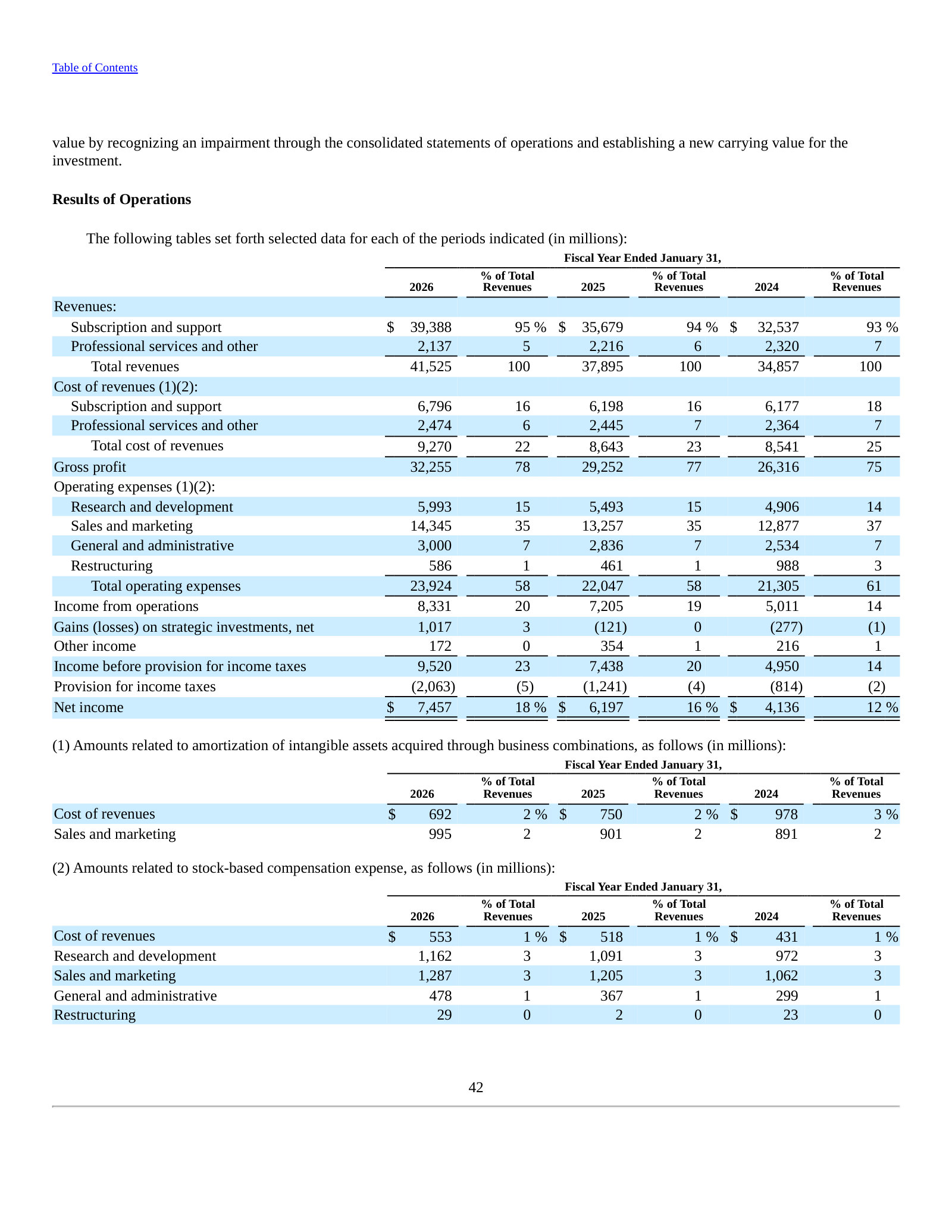
Growth came from volume, not price — new customers and upsell, with pricing not a significant driver.
The increase in subscription and support revenues for fiscal 2026 was primarily caused by volume-driven increases from new business, which includes new customers, upgrades and additional subscriptions from existing customers. Pricing was not a significant driver of the increase in revenues for the period.
p. 62 · Read in context →
Item 7. MD&A — Subscription and Support Revenues by Service Offering — p. 63 · Read the full section →
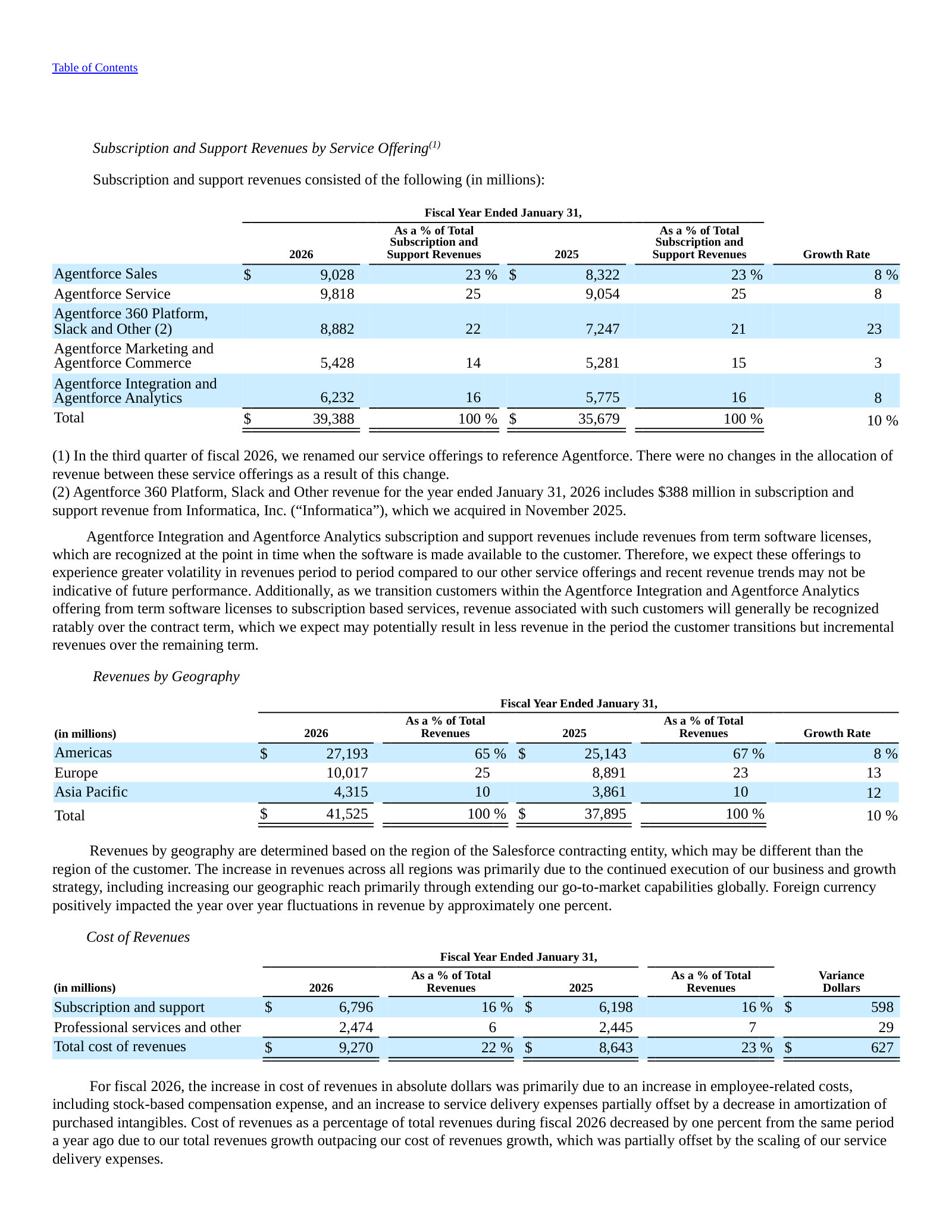
The closest thing to a segment breakdown: revenue and growth by product line, plus geography.
Item 8. Critical Audit Matter — Revenue Recognition — p. 79 · Read the full section →
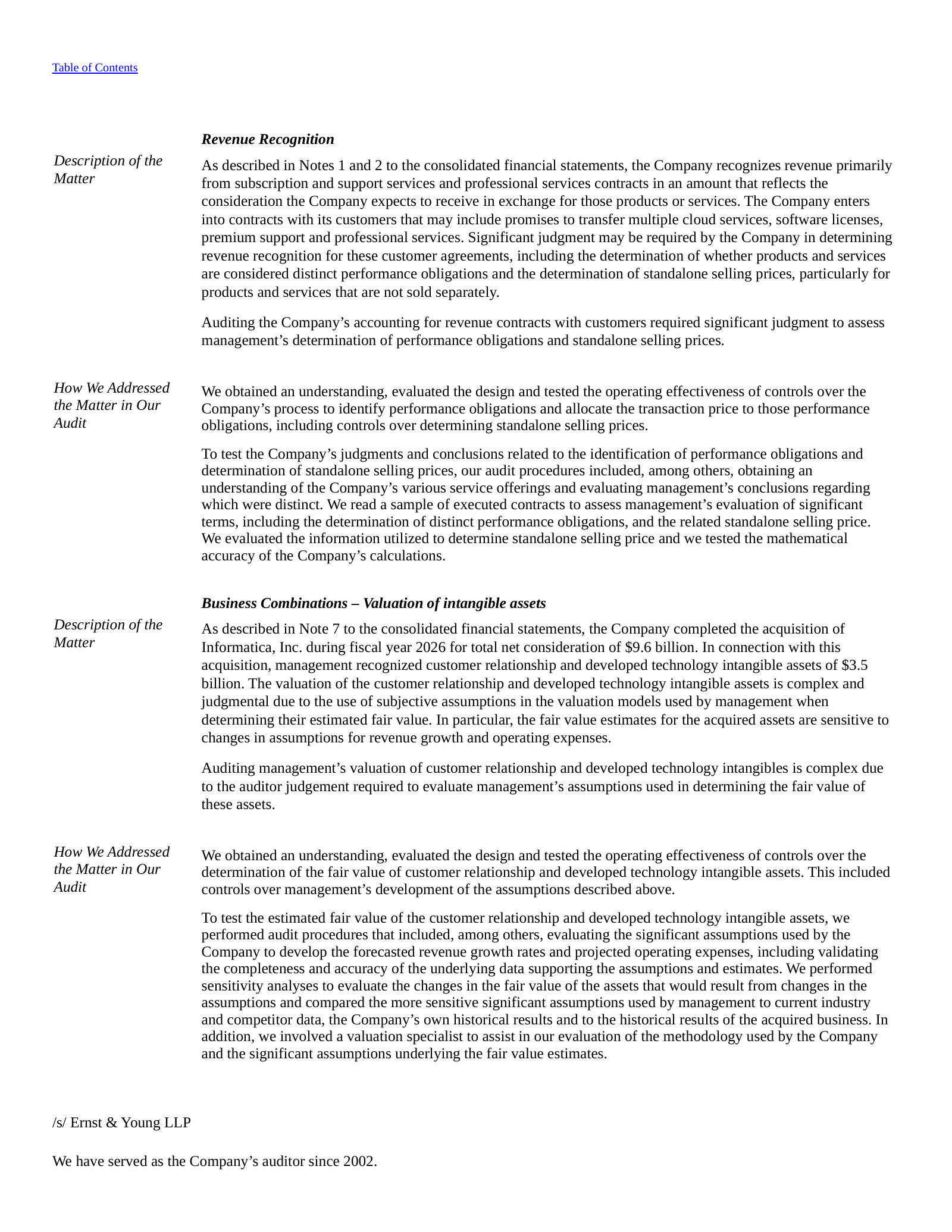
The auditors flag revenue recognition as the critical judgment — the accounting that defines a multi-element subscription model.
Salesforce, Inc. — FY2025 Annual Report (Form 10-K) — FY2025
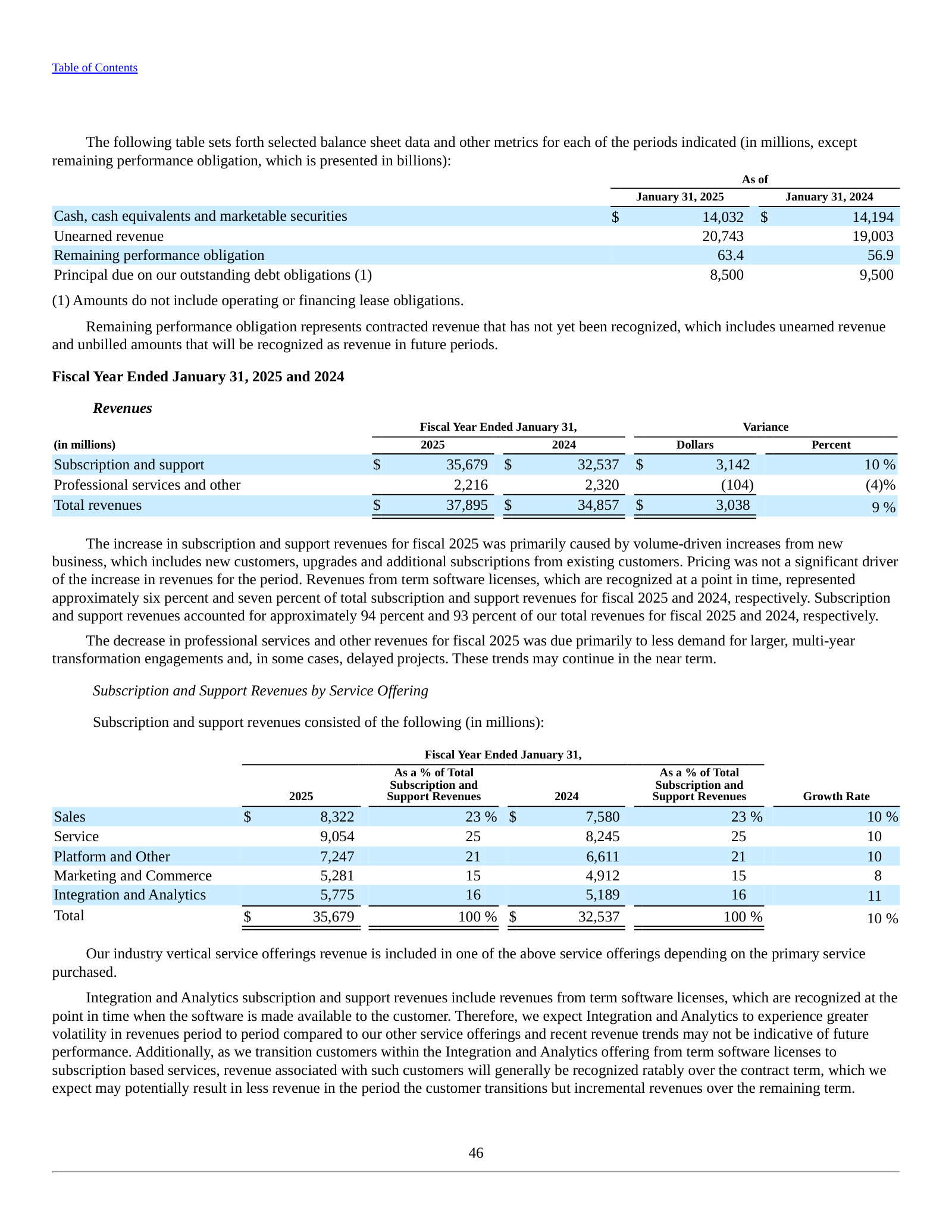
Included for one contrast: the same product lines a year earlier, before the FY2026 “Agentforce” rebrand of every offering. · Open the full document →
Item 7. MD&A — Subscription and Support Revenues by Service Offering — p. 67 · Read the full section →
Same dollar lines as FY2026 under the old cloud names — Sales, Service, Platform, Marketing and Commerce, Integration and Analytics.
More annual reports
Salesforce, Inc. — FY2024 Annual Report (Form 10-K) — FY2024 · 142 pages · The margin-turnaround year: operating margin jumped as restructuring and cost discipline followed activist pressure. · Open →
Salesforce, Inc. — FY2023 Annual Report (Form 10-K) — FY2023 · 102 pages · Peak-hiring aftermath: the report that set up the FY2024 restructuring and the profitability reset. · Open →
Salesforce, Inc. — FY2022 Annual Report (Form 10-K) — FY2022 · 104 pages · Post-Slack-acquisition baseline, before the AI pivot — useful anchor for the multi-year growth-to-margin story. · Open →